📘 Academic Writing
Order now
🇩🇿 New release · Delivery to all 58 wilayas

Write the answer the mark deserves

Written for university students of English at every level — licence, master and PhD entrance candidates. A methodological guide that teaches you to think, analyse and build a convincing academic answer under exam conditions.

  • Analyse any exam question and see what the examiner actually wants
  • Five complete model essays with expert commentary
  • Analysis of previous PhD entrance examination questions
  • Cash on delivery — you pay nothing up front
🛒Order your copy 📖About the book
2 000 DA + delivery · cash on delivery
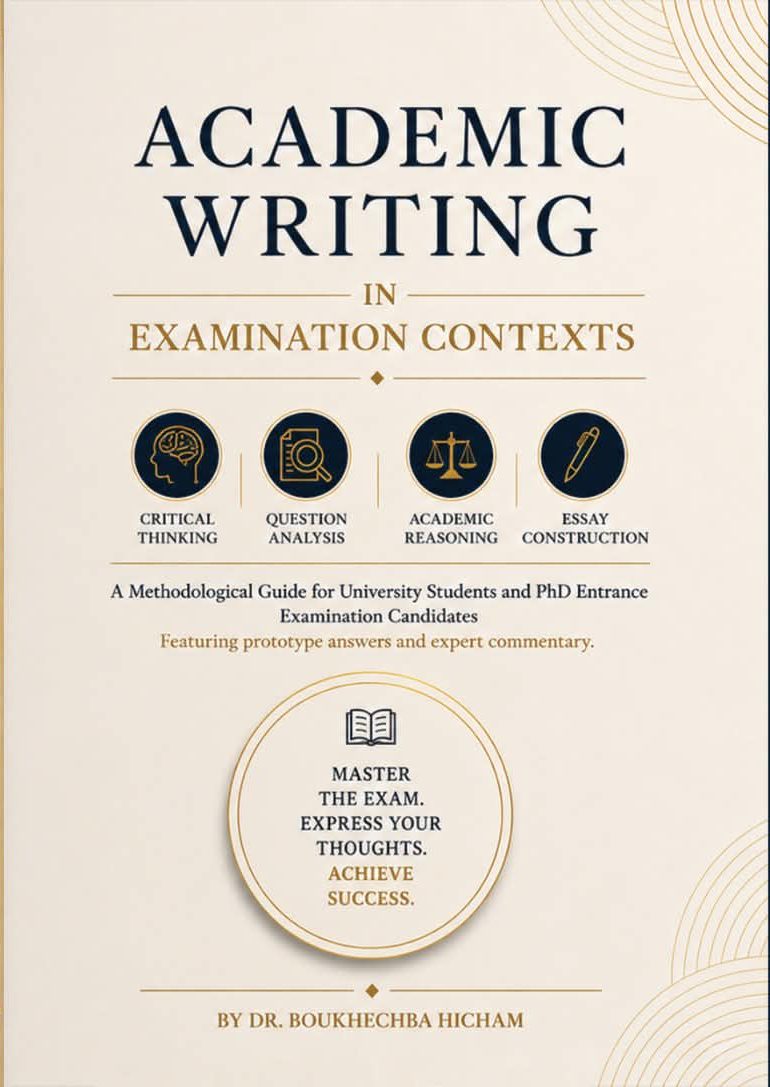
Academic Writing in Examination Contexts — front cover
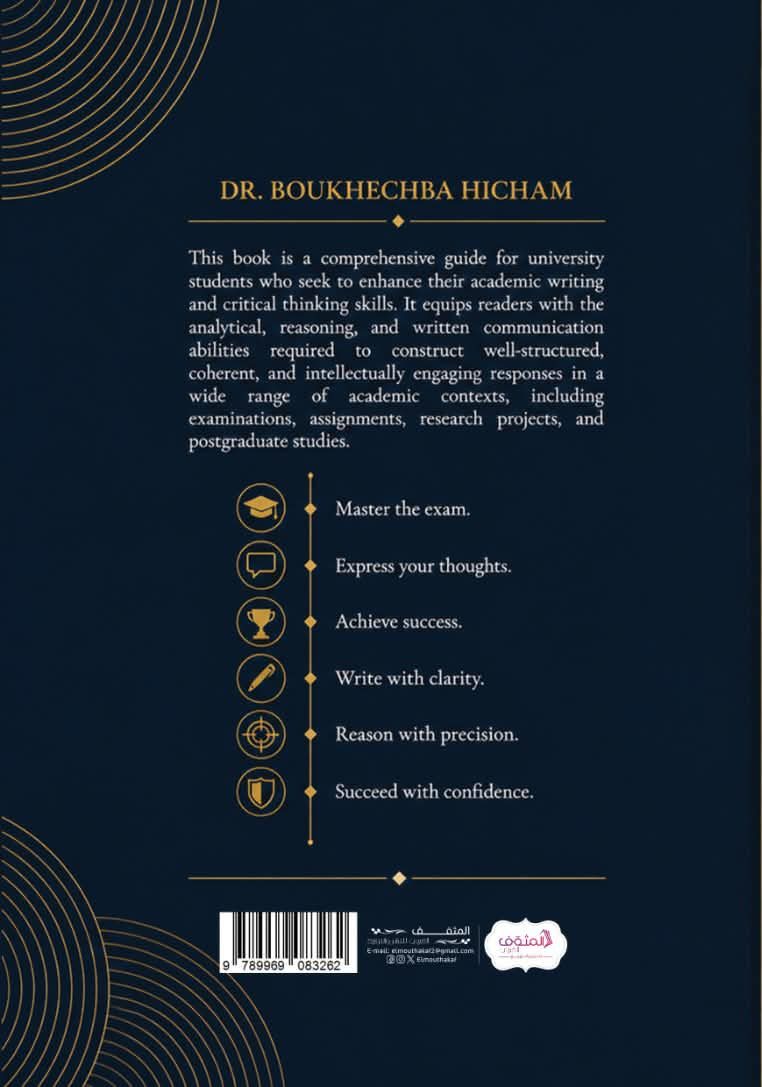
Back cover
🔄 Tap the cover to see the back
254+
pages
5
model essays
58
wilayas covered
250K+
followers
Who it is for
Every university student of English who sits written exams

If your mark depends on an essay you write in English under time pressure, this book was written for you — whatever your year or level. The chapter on past PhD entrance questions is one part of it, not the whole book.

Licence Master PhD entrance Semester & catch-up exams

You know the material — the mark says otherwise

The problem is rarely knowledge. It is turning what you know into a properly built answer, under time pressure.

😣 What happens in the exam

  • You write everything you know without answering the question asked
  • You miss the directive words: discuss, analyse, compare…
  • A long introduction with no clear thesis
  • Paragraphs stacked up with no logical thread
  • Time runs out before the conclusion

✅ What this book teaches

  • Break the question down and surface its implicit demands
  • A full table of directive words and what they really ask for
  • Reusable opening sentences and a precise thesis statement
  • Paragraph construction, transitions and coherence, step by step
  • Ready-made mind maps by specialism, to save time

Where this book came from

It was not written in a closed office. It grew out of years of teaching and supervision, and out of a private PhD preparation course.

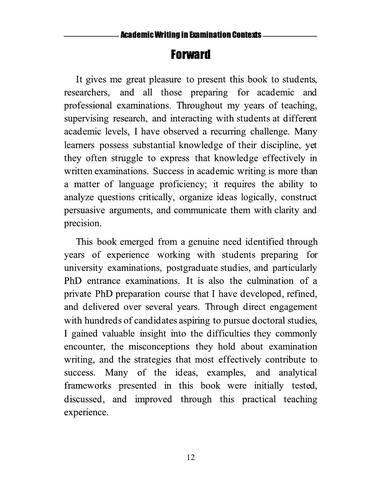
Forward page from the book Forward · p. 12

Across years of teaching and supervising research, the author kept meeting the same problem: students who genuinely know their discipline, yet hand in a script that shows almost none of it.

"Many learners possess substantial knowledge of their discipline, yet they often struggle to express that knowledge effectively in written examinations."

Forward · p. 12

The book is also the culmination of a private PhD preparation course the author developed, refined and taught over several years. Working directly with hundreds of candidates, he came to know the recurring difficulties, the common misconceptions about examination writing, and the strategies that actually make a difference.

Most of the examples and analytical frameworks in the book were tested with real students first — discussed and improved in the classroom before they reached the page.

Why every student of English needs it

Six reasons, each drawn from the book itself — not from marketing promises.

🌉

Because the gap is not in knowledge, it is in performance

You know the material, and the mark still lands below it. The book works on exactly that distance: how knowledge becomes a readable, convincing answer on the page — not how facts are collected.

Forward · p. 13
⏱️

Because the exam has rules of its own

Academic writing is usually taught as a generic skill, detached from real assessment. But an exam imposes its own constraints: limited time, a specific prompt, clearly defined expectations. The book builds strategies for that setting in particular.

Significance of the Book · p. 7
🔍

Because the question says more than it shows

"Discuss" is not "analyse", and "compare" is not "explain". A whole chapter is given to directive words: their roles, their overlaps, and the mental operations they demand without ever stating them.

Chapter 4.3–4.4 · p. 102–113
🧩

Because it shows the thinking, not just the result

Five complete model essays with expert commentary: why the paragraph opens this way, why that piece of evidence sits there. The model is not a text to copy but reasoning made visible — and reusable.

Chapter 6.7–6.11 · p. 157–208
🎯

Because entrance questions have a hidden logic

Thirty-six pages analysing past PhD entrance questions, closing with two sections on what those questions reveal and on the "hidden architecture" that recurs behind them. The aim is not memorisation but understanding how a question is built and judged.

Chapter 7 · p. 218–253
🌱

Because what you learn outlives the exam

Question analysis, critical thinking, reasoning, essay construction — skills that travel with you into research, the dissertation and professional communication. The exam is the occasion for learning them, not the end of it.

Significance of the Book · p. 8

Four skills the book builds

The book treats writing not as grammar, but as a process of thinking, reasoning and problem-solving.

🧠

Critical thinking

Build coherent reasoning instead of reciting content.

🔎

Question analysis

Read the prompt precisely and uncover unstated expectations.

⚖️

Academic reasoning

Arguments backed by evidence and a clear logical structure.

✍️

Essay construction

From introduction to conclusion: coherent, persuasive writing.

Written for students of English at every level

If you study English at university and you are graded on what you write in an exam, this book is for you.

🎓 Licence students of English 📚 Master’s students of English 🏛️ PhD entrance candidates 📝 Anyone resitting or catching up ✍️ Dissertation and thesis writers 🔬 Researchers 👩‍🏫 Teachers and supervisors

The book is not reserved for PhD candidates: its method applies to every written exam in English, from a first-year module to the entrance examination. The skills discussed in these pages serve coursework, research projects, dissertations, scholarly and professional communication too. The book does not claim to offer definitive or universally applicable answers: academic writing remains a dynamic activity shaped by disciplinary conventions, and what it proposes are methodological tools to adapt to your own context and objectives.

Lines from the book

Taken from the opening pages — before the real work even begins.

"Such an approach transforms writing from a mysterious talent into a skill that can be consciously learned, practiced, and refined."

📍Significance of the Book · p. 8

"The primary objective of this book is to bridge the gap between knowledge and performance."

📍Forward · p. 13

"Students are frequently expected to produce sophisticated academic responses under significant time constraints, often without receiving explicit guidance on how to approach questions strategically."

📍Forward · p. 13

"These questions represent more than isolated assessment items; they reveal recurring themes, intellectual expectations, and disciplinary priorities."

📍Forward · p. 14

"...transforming academic writing from a source of anxiety into a tool for intellectual growth and scholarly achievement."

📍Significance of the Book · p. 8

"Readers are guided from question analysis and critical interpretation to argument development, academic reasoning, essay construction, and response evaluation."

📍Preface · p. 15
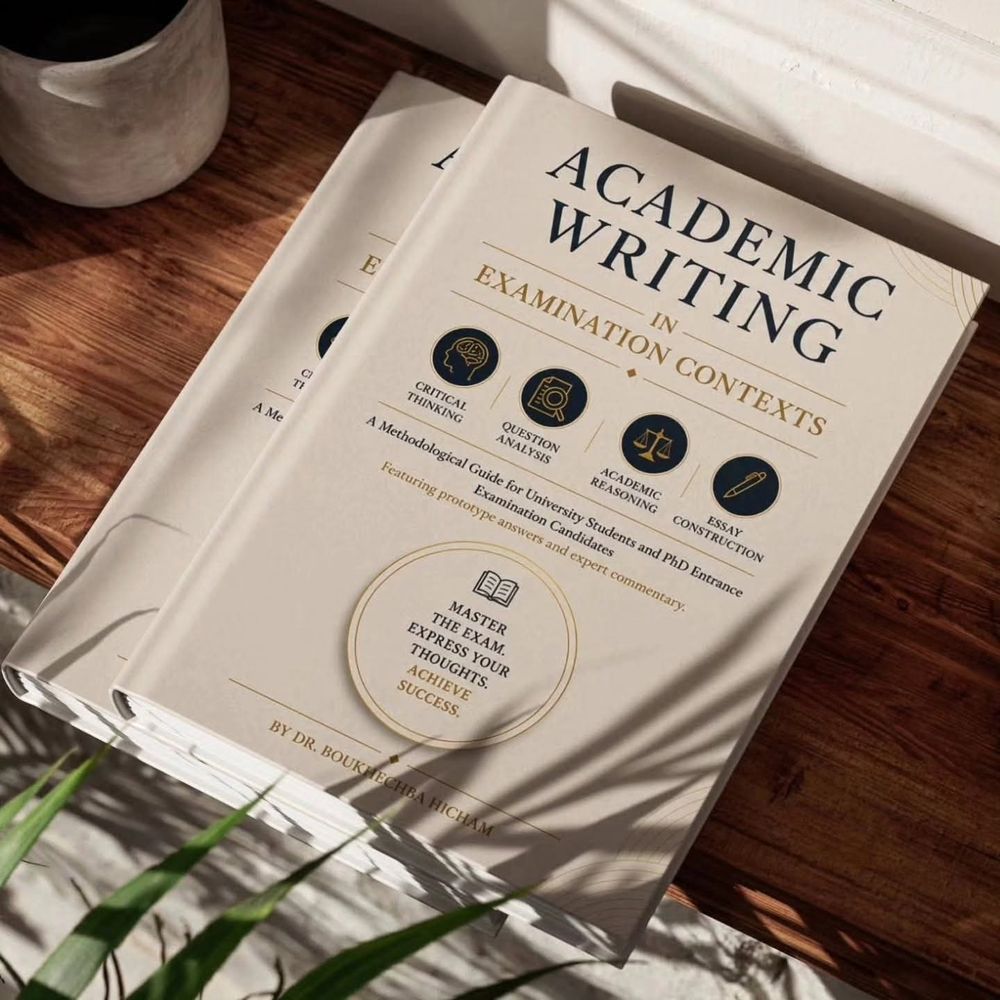
Academic Writing in Examination Contexts, hardcover copies
Hardcover · 254 pages · first edition, July 2026

What is inside the book

Seven progressive chapters, from what academic writing is to the analysis of past examination questions.

1Academic Writing21
2A Micro-Perspective on Writing32
3Logic and Mind Maps71
4Putting It All Together in an Answer98
5Writing the Introduction114
6Development · 5 model essays144
7Analysis of Previous PhD Entrance Examination Questions218
References254
🗂️Full contents and pages from the book

The full contents

Every heading and its page, as printed in the book. Tap a chapter to open it.

About the Author5
Significance of the Book7
Contents9
Forward12
Preface15
Why This Book Matters for All Students17
Disclaimer19
1.1 What is Academic Writing?21
1.2 The Architect of Thought24
1.3 The Collective Mind: Subject Matter and Logic26
1.4 The Essay as the Core Unit28
1.5 The Challenge of Writing in Official Exams30
2.1 The Audience32
2.2 The Dual Message34
2.3 The Tone in an Essay42
2.4 Formality44
2.5 Objectivity in Academic Writing55
2.6 Density in Academic Writing: Clarity and Precision, Conciseness65
2.7 Clarity68
2.8 Precision69
2.9 Conciseness69
3.1 Discipline-Specific Mind Maps72
3.2 Didactics73
3.3 Research Methodology82
3.4 English for Specific Purposes90
4.1 Linguistic Causes98
4.2 Cognitive Causes100
4.3 Directive Words in Academic Writing: Roles and Overlaps102
4.4 The Implicit Cognitive Operations of Directive Words111
5.1 The First Sentence114
5.2 The Reusability of First Sentences124
5.3 Practice: Reusable First Sentences125
5.4 The Thesis Statement127
5.5 The Thesis Statement in Exam Contexts129
5.6 Placement of the Thesis Statement in Exams130
5.7 Starting with the Thesis Statement139
6.1 The Logic of Expansion: From Sentence to Paragraph145
6.2 Beyond the Triadic Model: The Complex Structure of Development148
6.3 Cohesion and Coherence151
6.4 Development in Examinations154
6.5 The Collective Logic of Paragraphs155
6.6 The Conclusion: Closing the Argument156
6.7 Essay One: Blended Learningmodel157
6.8 Essay Two: Languagemodel179
6.9 Essay Three: Teacher's Rolesmodel186
6.10 Essay Four: Curriculum Developmentmodel193
6.11 Essay Five: Ethics in Researchmodel203
6.12 Beyond Writing: Learning to Think Academically209
7.1 What Previous PhD Entrance Examination Questions Reveal247
7.2 The Hidden Architecture of PhD Entrance Examination Questions250
References in the Book254

Section headings appear in English exactly as printed, because the book itself is written in English.

Pages from the book

Tap any page to enlarge and read it.

These are the front pages only. The seven chapters begin on page 21.

What sets it apart from other writing guides

Four methodological choices that separate it from the conventional manual.

🧠

Writing as thinking, not as grammar

Most guides stop at linguistic accuracy and paragraph organisation. This book treats writing as a process of thinking, reasoning and problem solving.

📝

Built for examination conditions

Limited time, a specific prompt, stated and unstated expectations — the strategies here are cut for that context.

🔬

From theory into practice

No principles suspended in the abstract: detailed analyses of real questions, prototype answers and expert commentary walking through each one.

💡

The reasoning made visible

Once the reasoning process is visible, students see how a successful response is constructed, from first interpretation to final conclusion.

About the author

HB

Dr. BOUKHECHBA Hicham

Associate Professor, Ziane Achour University of Djelfa, Algeria

His work spans research methodology, academic writing, English language teaching, EFL textbook evaluation, sociolinguistics, language education policy, teacher education and curriculum studies. He is particularly concerned with the relationship between educational policy, classroom practice and teacher cognition in the Algerian context.

He is the founder and administrator of "Dr. Boukhechba Virtual English Classroom", one of the largest educational communities dedicated to English language learning in Algeria, with more than 250,000 followers, offering continuous academic support to students, teachers, researchers and examination candidates.

"I hope that this book will encourage readers to approach writing not merely as an academic requirement but as a means of intellectual development." Preface · p. 16

Publication details

TitleAcademic Writing in Examination Contexts
AuthorDr. BOUKHECHBA Hicham
PublisherEl Mouthakaf El Arabi, Batna, Algeria
Legal deposit07/2026
ISBN978-9969-08-326-2
Pages254
LanguageEnglish
FormatMethodological guide · hardcover

Frequently asked questions

Cash on delivery. You pay the courier when the parcel reaches you, and nothing before that.
Yes, delivery covers all 58 wilayas. You choose home delivery or pick-up at the courier office in the form.
The fee is worked out automatically once you pick your wilaya, and the total is shown before you confirm.
The book is written in English, because it is written for university students of English — at licence, master and doctoral level alike.
No. It is written for every university student of English who sits written exams. The same skills — analysing a question, forming a thesis, organising paragraphs — decide your mark in a first-year module exam as much as in the entrance examination; the chapter on past entrance questions is one application of the method, not the whole book.
Usually two to five days depending on the wilaya. We contact you to confirm the order after you send it.

Ready to write a better answer?

The form takes under a minute. You pay nothing until the book arrives.

2 000 DA · + delivery · cash on delivery

2 000 DA Cash on delivery
Order now